1Introduction
- Author
- Leonardo Pinero-Perez
- Written
- 2018 · Thesis, University of Texas at Arlington
- Original
- Full thesis · 105 pages
- Contents
- Chapter 1 · 2 · 3 · 4 · 5 · Appendix A: Nomenclature · References · Acknowledgments and Biographical Information
Converted from the original PDF on with Claude Opus 5.5. The wording is unchanged, except: my name is spelled without accents, and Tables 1.1 and 1.2, pictures in the PDF, are typed out. Equations, figures and numbering follow the original. Conversion not yet checked against the PDF.
1.1Relevance of Thesis
1.1.1Applicability to Industry
The main theme of this thesis is to remove underlying conceptual assumptions for spacecraft design and build a parameterized, physics-based approach to unique vehicle design. In this way, the values for basic vehicle geometry can be selected in the proper combination to form the best configuration for a given mission. The focus of this thesis involves the configuration’s atmospheric performance for synergetic maneuvers and re-entry. The desired mission characteristics include inclination change and payload capability for a given vehicle weight.
The environments of other planetary bodies’ atmospheres do not have a history of design predecessors to draw from. Even for special Earth-orbital missions, such as radically changing orbital inclination by means of a lifting body, there are little to no historical precedents from which a conceptual design can begin. If a designer is to make an educated conceptual decision, all possible configurations must be assessed. For this reason, the author proposes building a multi-dimensional topology of possible designs based on basic geometry for a given mission and its environment.
Such a tool should not only accurately assess existing designs but should also be predictive in determining possible configurations for novel missions, most interestingly for a new planetary environment. Many of the challenges of human spaceflight are not from a lack of technology, but rather from the lack of implementing holistic synthesis strategies to arrive at an optimum multi-disciplinary design point to maximize performance. The goal of this thesis is to provide insight into surmounting the latter challenge with existing technology.
1.1.2Applicability to Senior Project
The author’s senior project focused on a high-performing lifting body design which will serve as a test point for validating the methodologies of this thesis. Additionally, the analysis methodology uses the geometry of the vehicle as an input, and the results found from these analyses will be part of the core processes of the code developed by the author. The results of the senior project also provide context for the development of a business case and global impact of vehicles with one of the key performance parameters: cross-range. This performance parameter is a component in the overall performance of several vehicles, both historical and hypothetical.
The next section will go over the main findings and implications of the mission and design of the project’s studied vehicle. The mission type and performance parameters involved in the senior project correlate to the assessment of vehicles in this thesis.
1.2Overview of Senior Project
1.2.1Global Context
This honors thesis is built upon the work from the author’s senior design project, which is to re-create and document the conceptual design process for a lifting-body return-from-orbit vehicle and its associated reusable launch platform. The senior project was conducted by Ascension Aerospace, which is a team composed of 21 undergraduate senior-level aerospace engineering students. This group project is the main deliverable for the MAE 4351 Capstone Design Course at the University of Texas at Arlington, Texas. The author’s role in this class team is that of the lead chief engineer. Much of the first chapter in this thesis is adapted from the author’s senior project report.
At the time of the writing of this thesis, the United States is falling behind in space warfare, and there has been renewed interest in the rapid development of hypersonic vehicles to counteract Russian and Chinese military strategy. This geopolitical situation is exemplified by United States President Donald Trump’s June 18th 2018 declaration, directing the department of defense and pentagon to initiate a sixth branch of the American armed forces, known as the “Space Force” [4]. This new initiative has the intent of increasing American military readiness and dominance within Earth’s orbital sphere-of-influence and beyond. Hypersonic vehicle development is an essential element of such an initiative. The generation of high-performing vehicle concepts for hypersonic flight is the focus of this thesis.
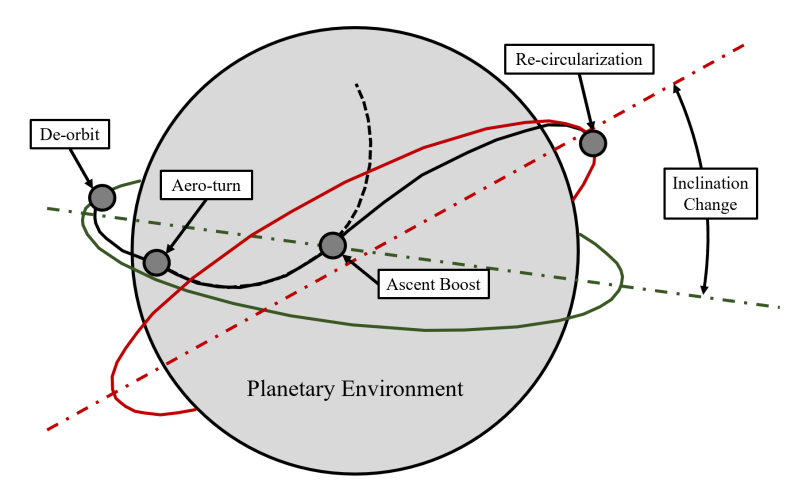
One useful application of a high-lift hypersonic craft is the ability to rapidly change the orbital inclination by descending from orbit into a hypersonic upper-atmospheric flight regime and using aerodynamic effectors to alter the trajectory. The spacecraft would then emerge into an exoatmospheric orbit at a new inclination accompanied by radically improved surface coverage.
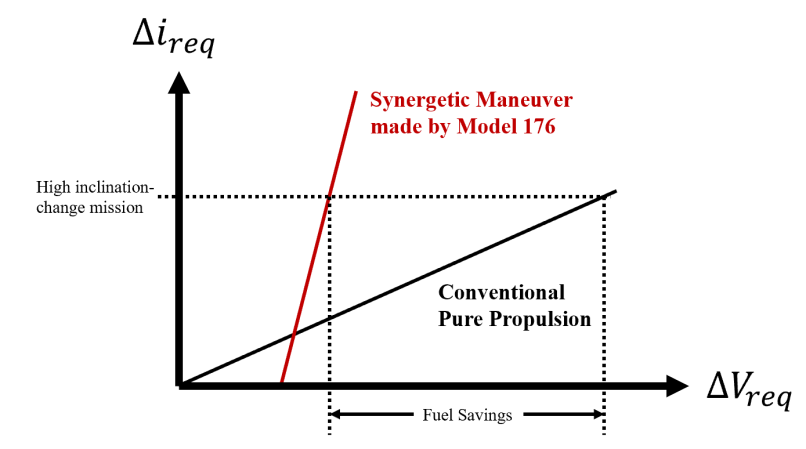
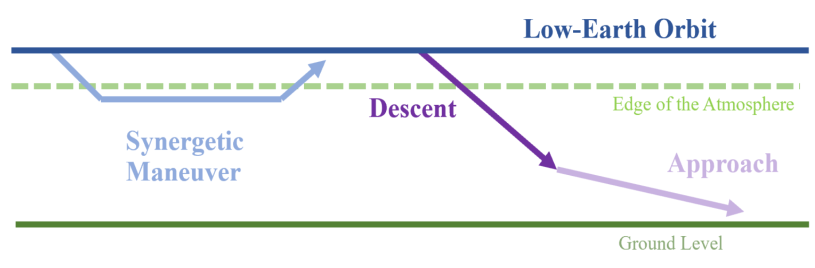
This application allows for surprise reconnaissance, which a purely orbital satellite is incapable of doing without expending copious amounts of fuel by chemical combustion. By utilizing a hypersonic reconnaissance vehicle, the operator has complete flexibility in major course corrections, which is especially useful for fast-paced, unpredictable military missions. Figure 1.2 roughly compares the performance of a high-lift vehicle such as the McDonnel Model 176 (the focus vehicle of senior project) and a conventional satellite which is required by its mission to change inclination. The current situation only permits predictable spy-satellite orbits which potentially allows an enemy to effectively hide operations and wait for the known spy-satellite to complete its overhead pass. With a maneuver synergetic with the aerodynamic properties of a specialized vehicle such as the Model 176 (focus of the senior project and a vehicle study in this thesis), the military can now utilize a high-inclination change missions originating from orbit. Additionally, a high cross-range capability is desired so that orbit time can be reduced, allowing the military craft to return to friendly territory (continental United States) at a moment’s notice. The mission profile of this craft’s synergetic maneuver can be generalized as shown in Figure 1.1 (adapted from [2]).
Later in this thesis, this comparison will be studied in greater detail to find how geometry affects the inclination-change performance. Vehicles of identical geometry will defer in performance as a function of planetary environment or method of inclination change (using either a synergetic maneuver or a purely propulsive system).
As shown, it is not feasible to carry the necessary fuel to make large changes in inclination by conventional propulsive means. It is worth noting that that conventional inclination changes are actually advantageous for lower inclination changes since the initial fuel cost is zero. A synergetic mission profile requires multiple burns to descend into the upper atmosphere and ascend into the new orbit [6].
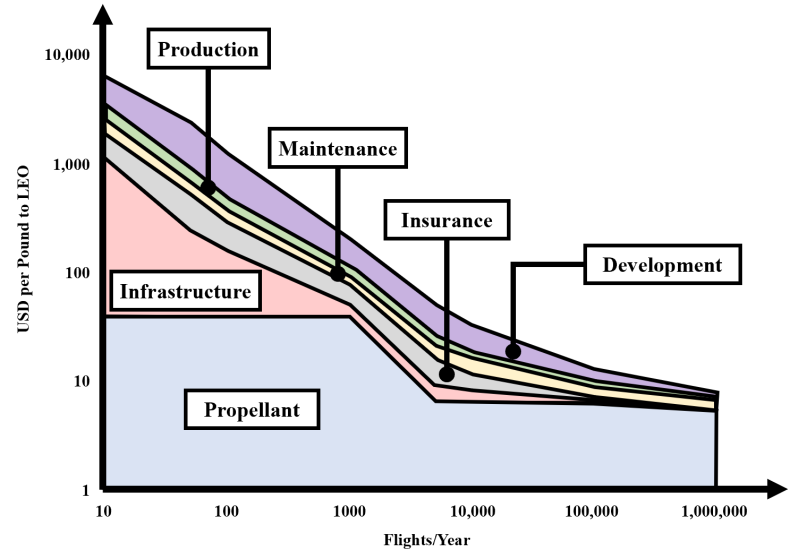
Even beyond military applications, it is advantageous to land the craft at any time, which allows for more logistical flexibility and increased frequency. In the civilian market, the logistical flexibility allowed by a reusable spacecraft with high cross-range capability will drastically reduce launch cost per pound. This is because existing infrastructure can be used multiple times to support increased flight frequency, driving down the cost of Low-Earth Orbit (LEO) transport. The cost-per-pound breakdown of operating a space vehicle as a function of flight frequency is shown below.
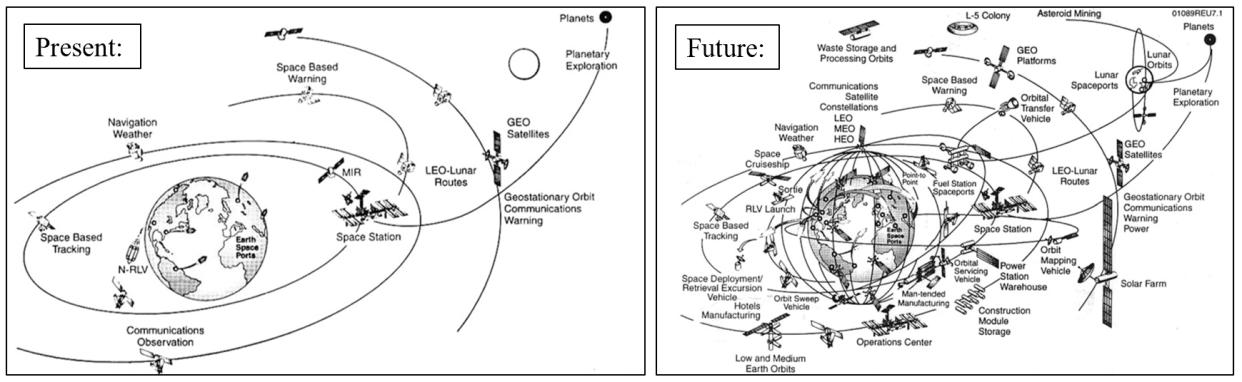
A spacecraft designed to meet the critical military mission requirement can also fulfill civilian applications such as Point-to-Point (PtP) transport. This vehicle has a special economic advantage because of its reusability and rapid turn-around time. A comparison of current space-launch operations with what they could be by reducing payload costs is shown in Figure 1.4. This is an illustration of the change in human activity from an increased flight-frequency due to increasing cross-range capability [7].
1.2.2Expectations and Team Organization
The following subsections in this chapter are composed of adapted excerpts from the introductory sections of the author’s senior project report [6]. They serve to provide more detail regarding the connection of ideas found in this thesis and the senior project work.
The author’s senior design project is centered around reverse engineering the methodology used to develop the McDonnell Military Model 176. The focus vehicle is to be used as an example later in the thesis. This mission includes a launch vehicle and a hypersonic vehicle, and the team is responsible for validating and explaining the underlying physics behind the design to prove that it is capable of achieving mission goals. This validation method is based on extensive literature research on the topics of hypersonic flight, aerothermal heating, mission operations, stability across speed regimes, and fully-integrated sizing methodology. Trade studies are then implemented in this methodology to find further modern-day applications of this design.
There is much research which pertains to the hypersonic vehicle, such as work on the characteristics of lifting bodies and hypersonic aerodynamics. The Model 176 was recently declassified, so these documents provide a catalyst for developing the reverse engineering methodology as well as validation data. This defers from designing a completely novel vehicle, as this team’s methods must now produce a physical truth that was developed historically. Design from the ground up does not have any physical validation, so there is significant room for faking erroneous results which could easily pass by review. Since there is a physical basis to verify this design, an inadequate methodology will be quickly discovered in this project’s scope. However, this leaves the temptation to develop a trivial methodology which overly relies on the validation data. It must be made clear that the methodology must be derived from an independent knowledge-base of physics, multi-disciplinary analysis, and commonalities with historical vehicle precedents. The combined vehicle, with the Model 176 and launch system, is shown in Figure 1.5 alongside comparative configurations [8]:
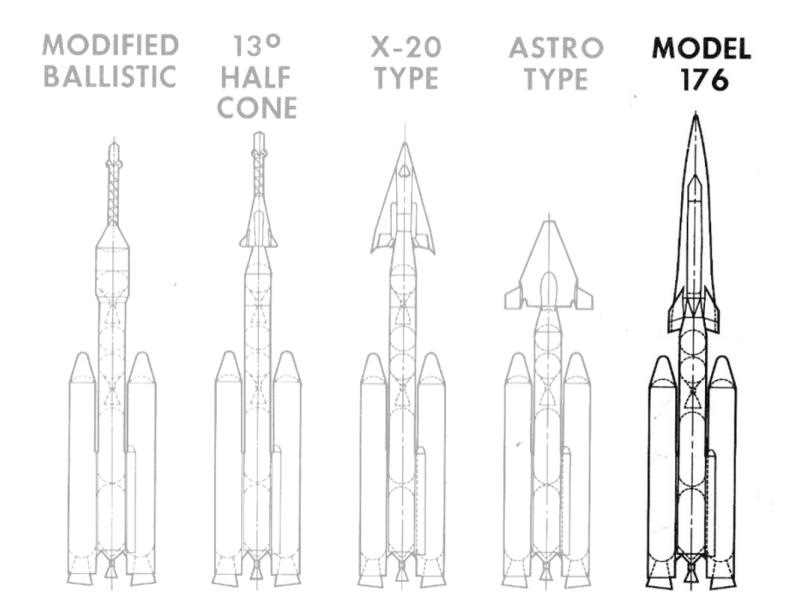
For the launch platform, the existing vehicles used are SpaceX’s Falcon 9 B5 and Falcon Heavy, which will be reverse-engineered. One of the main tasks of the launch team is to apply the SpaceX launching platforms (Falcon B5 and Falcon Heavy) as a new launch platform for the Model 176. One of the main advantages of these platforms is that the lowest, largest stages are fully reusable, which removes most of the expendable characteristics from the total mission.
The mission requirements for the design in question concern the development of a concept for a re-usable, manned space transport system, which is capable of orbital operations, fuel-efficient orbital maneuvering by atmospheric entry and exit, and point-to-point global transport. Such a vehicle must be integrated into some launch platform, and two sub-teams are created to divide the task of developing the upper stage hypersonic vehicle and launch vehicle.
The team is split into two main groups: one focuses on the hypersonic vehicle, the other reverse-engineers the launch system. Both teams are headed by the author, who is the chief engineer for the hypersonic vehicle. Both chiefs are involved in their respective vehicle’s synthesis and are to determine costs and the business case for a mission. The structure and domains of work for the rest of the team are shown below, which is divided by discipline.
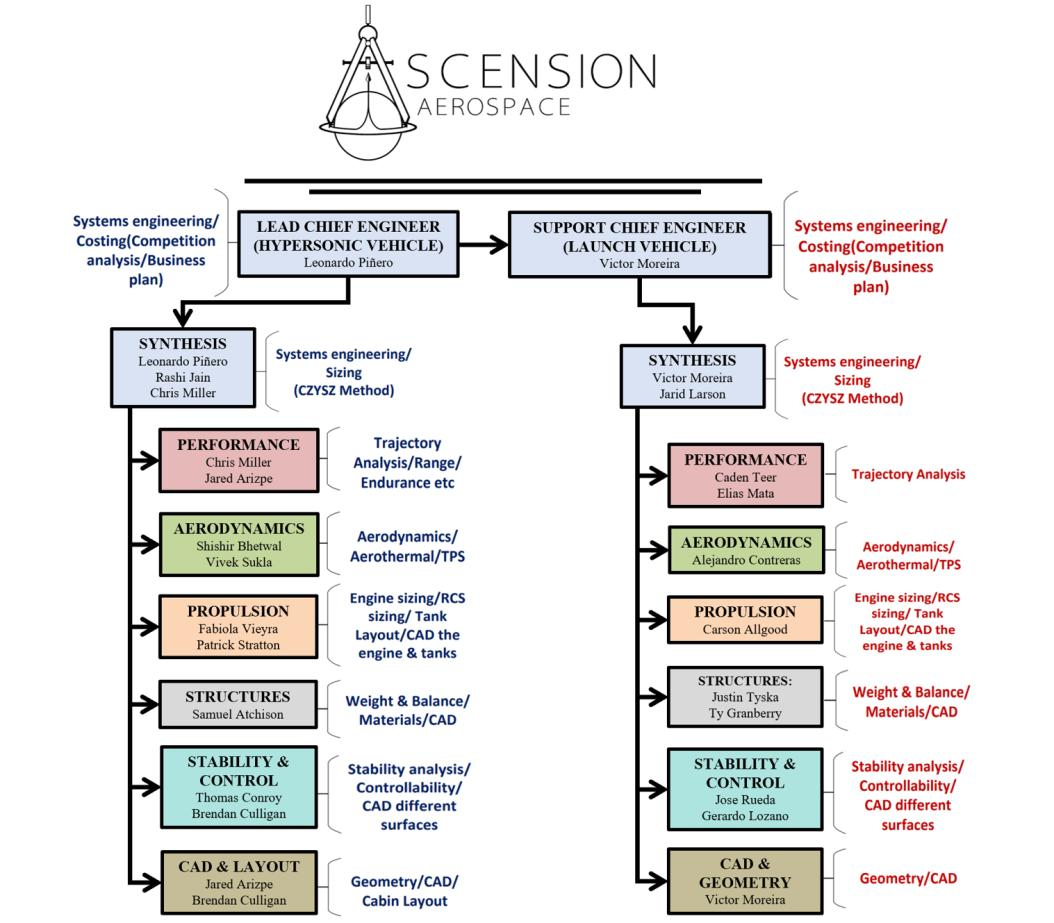
1.2.3Roles of Author in Team
The author’s main work is to direct and bring together the many aerospace disciplines in the class team into one cohesive design. This includes writing the team report, building the methodology for multi-disciplinary analysis, creating one synthesized script, and developing a sizing methodology to provide key design parameters that meet the mission. This position is unique in that it must be familiar with the roles of all disciplines to build the bigger picture of the purpose of design.
The author must also develop a business case for the mission to meet military and market needs. The methodology and early decision-making in conceptual design usually determines the success of a program. For this reason, the role of developing the multi-disciplinary analysis and methodology bears a large responsibility.
Additionally, the role of chief engineer contains a significant human element. It is the responsibility of the author to make sure team deliverables are completed on schedule and every group member is contributing to the team effort. The chief is also the arbiter of disagreements over deliverables and domains of work. There is a general team workflow that must be nurtured, and this requires a balance between what is realistic to complete in the summer semester timeframe and what must be done to produce an exceptional project.
1.2.4Business Case
As part of the project deliverables, the author has composed a commercial business case for a high cross-range lifting body vehicle such as the Model 176. The results here are condensed, as they only serve to provide additional context for a focus design. From this business case, a mission profile is created and its associated mission parameters are formed. These parameters connect the physical aspects of a vehicle to a commercial and military purpose.
The business case begins with the assessment of the global market for accessing low-earth orbit. After reading through several documents of market research, the author believes there is global interest in sustaining a frequent launch rate. The vehicle in question can fulfill the market need for rapid point-to-point transportation. The flight profile of such a service will include trans-Pacific and trans-Atlantic flight. The vehicle’s ability to access this market is limited by launch sites, but one-way trips are still available from a launch site to a runway of suitable length.
For any transportation vehicle, the amount of the market which it can capture is a function of its range. An orbit-capable craft can capture close to the entire global market since its cross-range has global access upon reaching orbital velocity above the atmosphere. However, the orbit-capable vehicle is limited by the available launch sites. To capture as much of the market as possible, it is planned to transport passengers by conventional subsonic means to the nearest launch site before embarking across the world. By doing this, the total time of travel is expected to be within the order of magnitude of a supersonic or hypersonic flight, where all high-velocity aircraft will drastically reduce flight time for a premium when compared to conventional air travel available today.
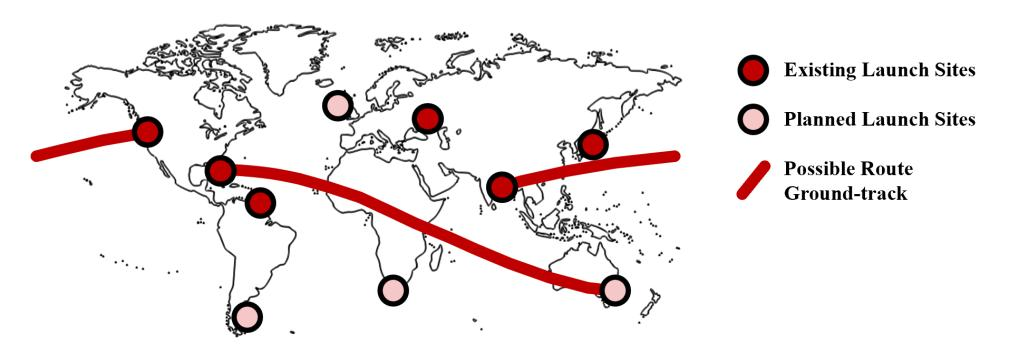
Since purchasing a ticket for high-speed flight will allow for a short flight duration (about an hour), the minimized passenger fatigue can increase productivity. Highly compensated executives likely cost their employers considerable money for their time, including during a less-productive flight. Even if the aircraft is enabled with an internet connection, the personal value an executive brings is reduced when on travel. Essentially, the company would much rather have an executive at their destination rather than in-flight. These incentives from a customer company will provide a better argument for paying for the expectedly high price per point-to-point ticket.
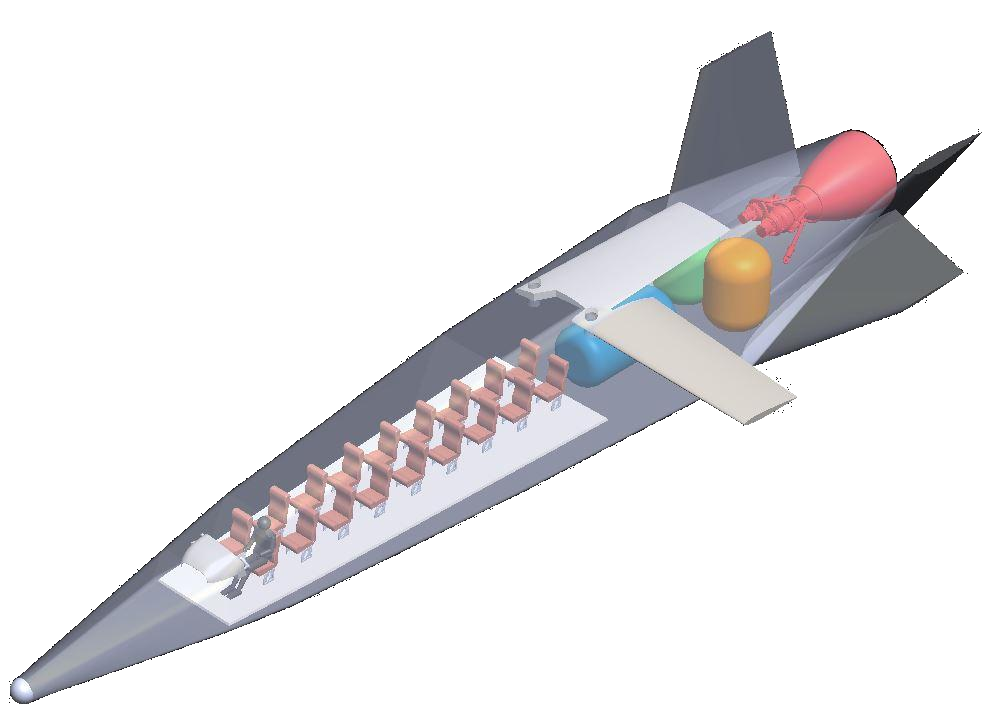
Realistically, due to weight sensitivity and volume constraints, the in-flight accommodations aboard an orbital point-to-point transport will be less than that of a fully-equipped first-class ticket on a larger subsonic vehicle. However, this can be more easily tolerated since the actual flight time is very short and comparable to a daily commute.
The market estimates for supersonic markets are conservative since orbital transport is potentially faster than a hypersonic flight (depending on the onboarding and offloading procedure). An additional conservatism is that customers are more willing to fly on a space vehicle for the cultural prestige and exhilarating experience associated with such a mode of transport. For these reasons, companies and individuals may be willing to pay a premium for tickets and the potential market for space flight is actually much larger than the market for atmospheric supersonic and hypersonic flight.
The market for paying for transport to low earth orbit is larger than the author expected and allows for enough revenue to support the program proposed by Ascension Aerospace. The tabulated values of market interest are shown below [1].
| Ticket Price | US Passengers/Year | World Passengers/Year | Revenue/Year ($B) |
|---|---|---|---|
| $72,000 | 7,500 | 150,000 | $10.80 |
| $24,000 | 137,500 | 550,000 | $13.20 |
| $12,000 | 237,500 | 950,000 | $11.40 |
| $6,000 | 600,000 | 2,400,000 | $14.40 |
| $2,000 | 1,250,000 | 5,000,000 | $10.00 |
It is worth noting that these numbers are conservative given that the lack of such a service makes market estimates speculative. The source assumed that only 25% of positive respondents would actually purchase a ticket should a service for orbital transport appear. This is a conservatism and does not account for the increased demand after the presence of affordable orbital transport.
Infrastructure expenses are a function of the yearly flight rate. Fortunately, the infrastructure price per pound in orbit decreases with increasing flight rate since the relationship between flight rate and total infrastructure required is not linear. The cost of infrastructure is tabulated below [1]. Maintenance works in a similar way, with manhours per flight decreasing with increasing flight rate.
| Flight Rate/Year | 10 | 50 | 100 | 1,000 | 5,000 | 10,000 | 100,000 | 1,000,000 |
|---|---|---|---|---|---|---|---|---|
| Yearly Infrastructure Cost ($M) | 300 | 300 | 350 | 400 | 400 | 600 | 1,200 | 3,000 |
| Cost/Flight ($) | 30,000,000 | 6,000,000 | 3,500,000 | 400,000 | 80,000 | 60,000 | 12,000 | 3,000 |
The yearly profits can now be evaluated for a 16-passenger orbit-capable transport. Using the results from previous sections, the revenues and costs of a scheduled space program are shown below.
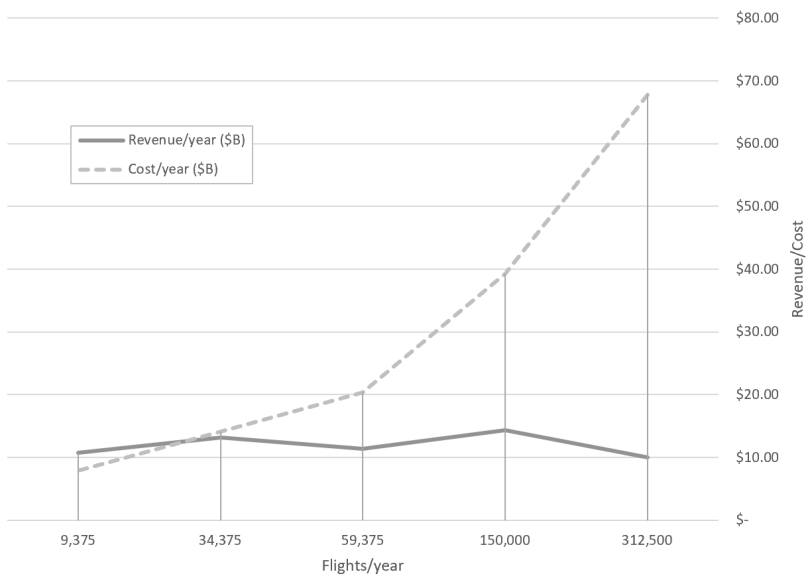
The business model is not profitable for higher launch rates since the total revenue does not match the increased costs of running such a large operation. While the price per payload pound to LEO is cheaper for such high flight rates, the global market is not large enough to pay for it. As previously mentioned, if the flight rate were decreased by increasing the ticket price, there comes a point where the demand is too low for regularly scheduled flights, which would not utilize the vehicle’s high turn-rate capability.
The selected flight rate is chosen to be 8,760 per year since this corresponds to one flight per hour year-round. This is also close to the lower limit of regularly schedules flight rates for a vehicle of this size. The price per ticket can be determined as an extrapolation of the market data and is found to be 73,200 USD. By extrapolating the demand curve, the decrease number of flights allows the operation to slightly increase the ticket price. This is helpful since a decreased flight rate also increases the price per flight, as shown in previous sections.
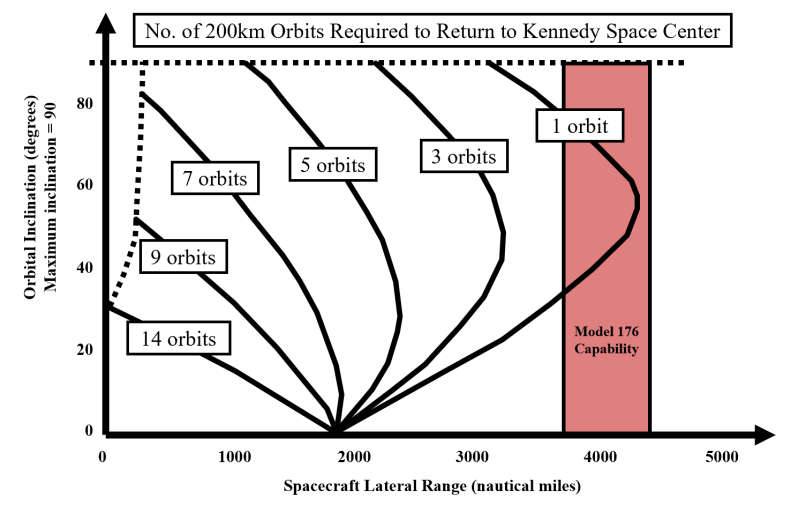
The effects of cross-range capability on orbital wait time are shown in Figure 1.10. For a given inclination, the runway must be perfectly aligned with the orbital path if there is low cross-range capability. A reduction in wait time greatly reduces operational costs. If a vehicle could be readily sent to orbit and rapidly recovered, the relative logistical and business benefits to run such an operation are significant. This is further explored in the business case developed for the Model 176 in the senior project [6], summarized later in this chapter.
The size of the fleet is dependent on the expected turn-around time. If the turn-around time for these vehicles were once a day (which is the optimistic limit), then a fleet of 25 vehicles can be maintain operations. At the conservative estimated turn-around time of 48 hours, a fleet of 50 vehicles is required to meet market demand. The extra vehicles are to allow slack for maintenance and emergencies. It is quite possible that the initial flight rate is not attainable due to constant learning and troubleshooting at the early stages of operation.
The fleet will also include military variants paid for by the Department of Defense, but this cannot be predicted or scheduled in the same way as market demands. The monetary value of these contracts will need to be assessed separately. However, the civilian supported infrastructure will allow for a lower operational cost for these special vehicles.
1.2.5Model 176 Mission Profile
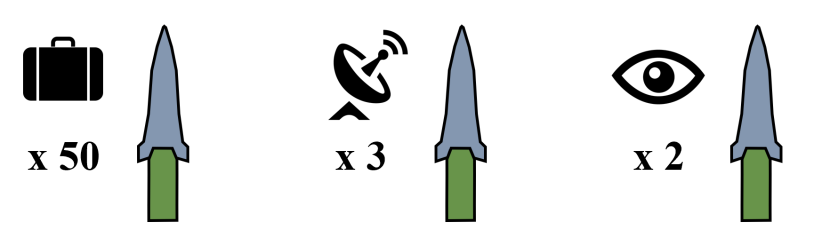
The mission profile is now determined based on the operational goals for each of the three variants. The point-to-point variant will be the most common layout, as it will support the civilian market. The layout, as shown in the previous section, includes 16 passenger seats. This variant is the lightest of the three, and rightly so, as these missions will generate the least revenue in lower ticket prices to capture as much of the market as possible.
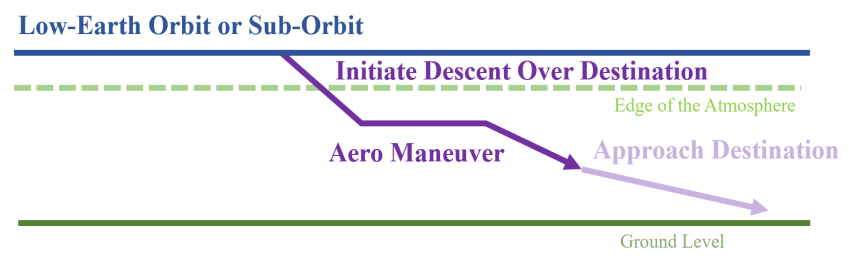
During descent, the vehicle may initiate an aerodynamic maneuver to increase its lateral ground-track. Doing this will allow the craft access to more airports outside of its direct orbital path. Much of the purpose of the point-to-point mission was described in the business case, where the main idea is to have as much access to as many destinations as possible to create the demand to support a sustained flight rate, lowering costs. These lowered costs allow for greater flight rate, and so on and so forth.
Additionally, the sustained flight rate is made cheaper by reducing the number of vehicles in the fleet. Keeping the fleet size at 50 (as described in the business case) requires a turn-around time. The Model 176 has a lateral range capability which allows for a turn-around time within the orbit. This is required if the vehicle will be ready the next day.
The Command-and-Control variant is an orbit-capable craft designed to conduct military operations independently in space. This can include satellite repair, bringing supplies and equipment to orbit, or coordinating space activities with human presence in low-Earth orbit. Whatever the operation may be, this variant is designed with a higher payload capability for life-support to sustain up to 5 astronauts. Additionally, the craft retains the capability to land safely on continental U.S. soil at any time.
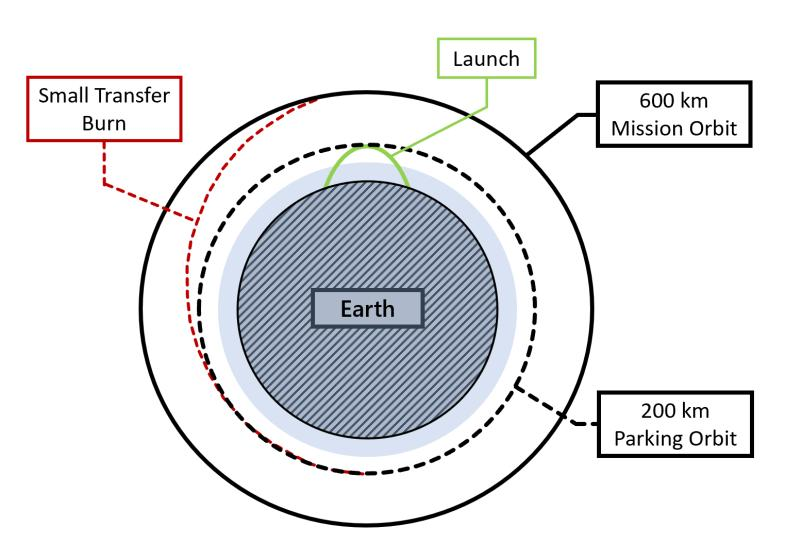
A simplified diagram of the mission profile is shown in Figure 1.13. If the fact that this variant is designed for a week of operation with extra payload is ignored, this is profile is similar to the other two minus their respective added capabilities.
The design-critical mission takes advantage of the lifting qualities of a hypersonic lifting body in another way. The orbiting stage can use its engine to descend into the atmosphere and make a turn by using the lift to perturb the orbit so that it can change inclination. The new orbit allows for surprise reconnaissance of any location on earth while using minimal fuel for a trajectory change. The only fuel required is used to decelerate to descend into the upper atmosphere and then to increase speed back to orbital velocity. This maneuver will be examined in depth later in the thesis. Minor orbital maneuvering can be used to alter inclination slightly or rendezvous with another body in Low-earth Orbit.
By adding this maneuver, the reconnaissance variant experiences the design-critical mission profile which is most demanding on the vehicle sizing in terms of fuel and volume required. The mission profile for the upper stage can be summarized by Figure 1.14.
The combination of this upper stage with the launch system provides the full mission profile. There is a delta V requirement at launch to insert itself into orbit, as the historical Titan III launch system was not able to carry the upper stage. This is the heaviest variant, since it needs to carry fuel for the burns shown in Figure 1.14.
The three variants are designed to operate in conjunction with each other, utilizing the same infrastructure and scheduled with respect to predictable operations to meet the existing civilian and military demands.
Spotted an error, or want to reply? Email me: leonardo.pinero42 [at] gmail [dot] com