IIntroduction
- Author
- Leonardo Pinero-Perez
- Written
- 2018 · Report, University of Texas at Arlington
- Original
- Full report · 120 pages
- Contents
- Nomenclature · Chapter I · II · III · IV · V · VI · VII · VIII · IX · X · XI · Appendix · References
- Ref
- MAE 4351-2018
Converted from the original PDF on with Claude Opus 5.5. The wording is unchanged, except: two classmates’ names are replaced by their roles, Figure 54 (an attendance sheet) is omitted, and my name is spelled without accents. Equations, figures and numbering follow the original. Conversion not yet checked against the PDF.
AProject Scope
The following report documents the conceptual design process for a hypersonic and launch vehicle pair conducted by Ascension Aerospace, a team of 21 undergraduate senior-level aerospace engineering students, as the main deliverable for the MAE 4351 Capstone Design Course at the University of Texas at Arlington, Texas. This report is focused on the roles of the author as the lead chief engineer.
This design project is centered around reverse engineering the methodology used to develop the McDonnell Military Model 176. This mission included a launch vehicle and a hypersonic vehicle, and the team is responsible for validating and explaining the underlying physics behind the design to prove that it is capable of achieving mission goals. This validation method is based on extensive literature research on the topics of hypersonic flight, aerothermal heating, mission operations, stability across speed regimes, and fully-integrated sizing methodology. Trade studies are then implemented in this methodology to find further modern-day applications of this design.
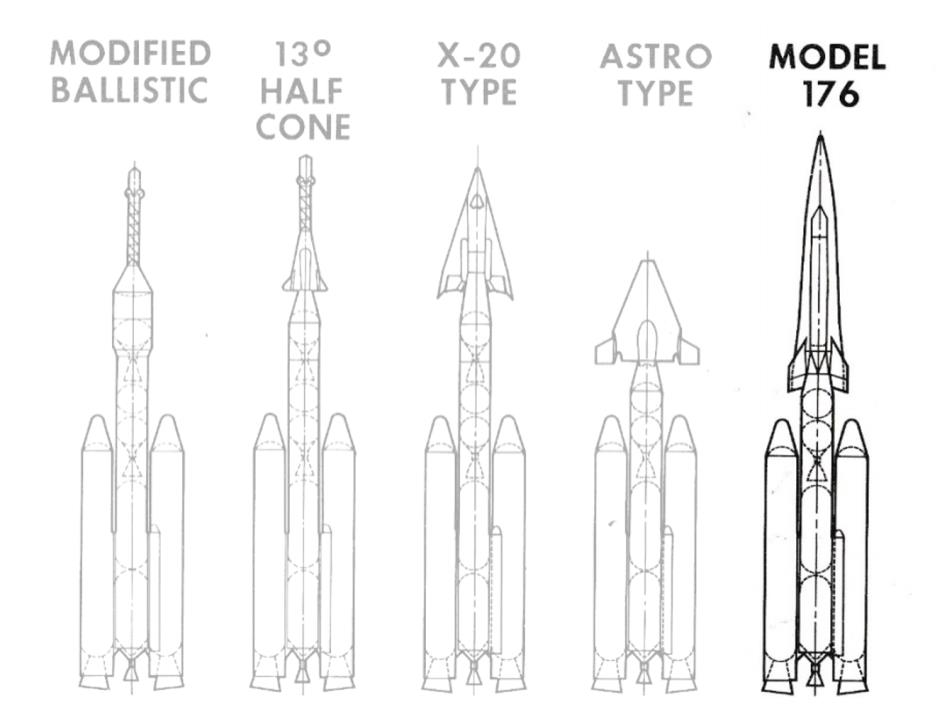
There is much research which pertains to the hypersonic vehicle, such as work on the characteristics of lifting bodies and hypersonic aerodynamics. The Model 176 was recently declassified, so these documents provide a catalyst for developing the reverse engineering methodology as well as validation data. This defers from designing a completely novel vehicle, as this team’s methods must now produce a physical truth that was developed historically. Design from the ground up does not have any physical validation, so there is significant room for faking erroneous results which could easily pass by review. Since there is a physical basis to verify this design, an inadequate methodology will be quickly discovered in this project’s scope. However, this leaves the temptation to develop a trivial methodology which overly relies on the validation data. It must be made clear that the methodology must be derived from an independent knowledge-base of physics, multi-disciplinary analysis, and commonalities with historical vehicle precedents. The combined vehicle, with the Model 176 and launch system, is shown below alongside comparative configurations [1]:
For the launch platform, the real-world vehicles used are SpaceX’s Falcon 9 B5 and Falcon Heavy. These will be reverse-engineered. One of the main tasks of the launch team is to apply the SpaceX launching platforms (Falcon B5 and Falcon Heavy) as a new launch platform for the Model 176. One of the main advantages of these platforms is that the lowest, largest stages are fully reusable, removes most of the expendable characteristics from the total mission.
The mission requirements for the design in question concern the development of a concept for a re-usable, manned space transport system, which is capable of orbital operations, fuel-efficient orbital maneuvering by atmospheric entry and exit, and point-to-point global transport. Such a vehicle must be integrated into some launch platform, and two sub-teams are created to divide the task of developing the upper stage hypersonic vehicle and launch vehicle.
Additionally, this report includes a business case before disciplinary analysis to first show that this configuration is economically viable in addition to the underlying physics and engineering choices.
BGlobal Context and Applications
The United States is falling behind in space warfare, and there has been renewed interest in the rapid development of hypersonic vehicles to counteract Russian and Chinese strategy. One application of a hypersonic craft is the ability to rapidly change the orbital inclination by descending from orbit into a hypersonic upper-atmospheric flight profile and using aerodynamic effectors to alter the trajectory [1]. This application allows for surprise reconnaissance, which is a maneuver that an orbit-only satellite is incapable of doing without expending copious amounts of fuel. The capability to efficiently change the inclination of an orbit at such high speed is what makes this upper stage unique. By doing this, the military craft has complete flexibility in major course corrections, which is especially useful for military reconnaissance. The current situation only permits predictable orbits which can potentially allow an enemy to effectively hide operations by waiting for a known satellite to pass.
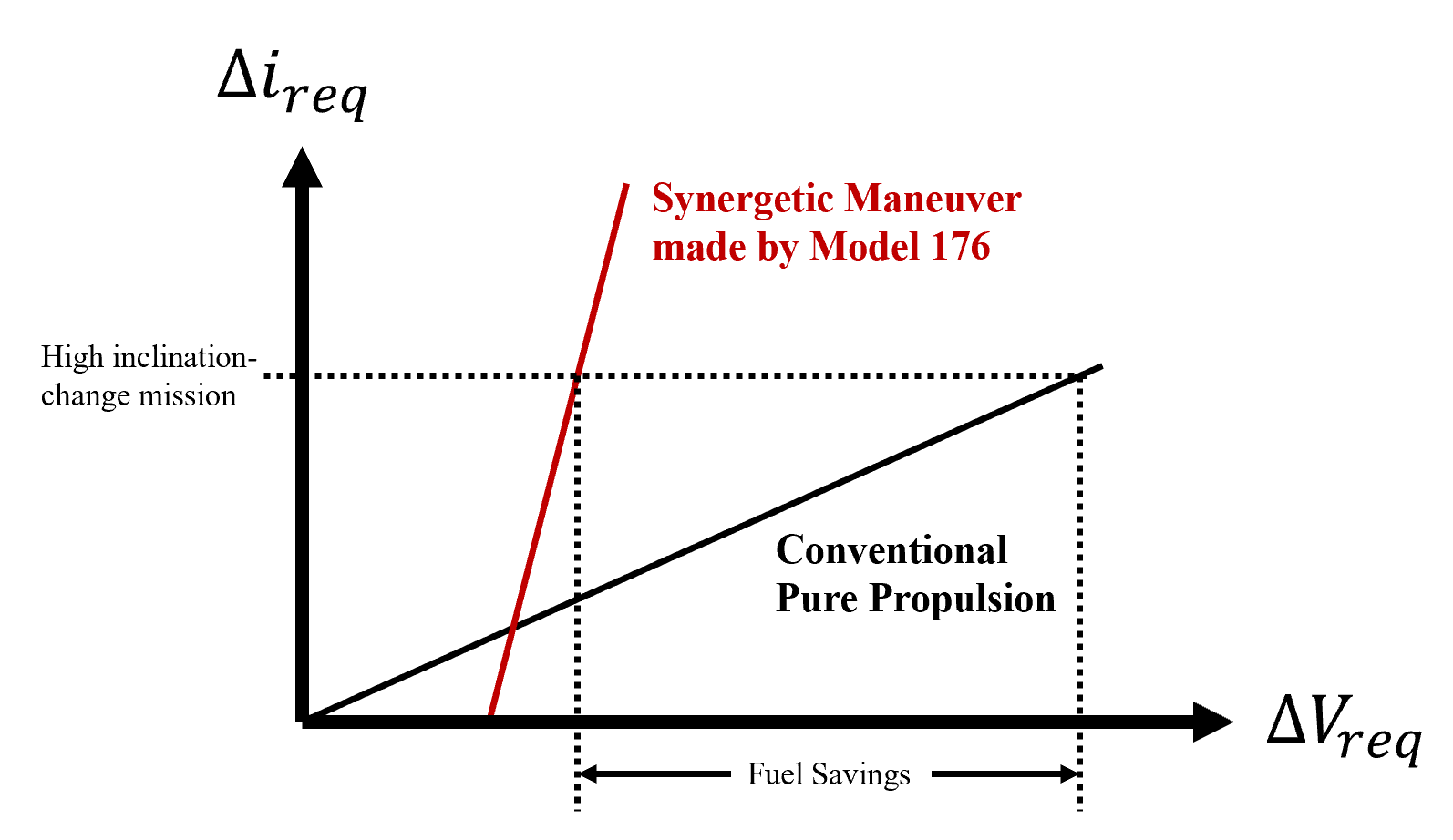
The figure below demonstrates the relationship between the momentum change required for an in-orbit inclination change. This plot is qualitatively derived from an observation of the two systems’ required mission profiles. It is apparent that for high inclination-change missions such as those required for dynamic reconnaissance, the superior design is that which uses a maneuver synergetic with the momentum imparted on the atmosphere at the expense of energy loss due to drag. The slope of this line is directly related to the ratio between lift and drag. In terms of orbital mechanics, this is analogues to the ratio between to normal or anti-normal thrust and orbital decay.
One other observation is that conventional inclination changes are actually advantageous for lower inclination changes since the initial fuel cost is zero. A synergetic mission profile requires multiple burns to descend into the upper atmosphere and ascend into the new orbit.
Additionally, a high cross range capability is desired so that orbit time can be reduced. It is advantageous to land the craft at any time, which allows for more logistical flexibility. The capability for high lateral range allows for rapid turn-around time, which is a mission performance requirement to allow for the feasibility of the business case presented.
The geography of the Earth’s surface is assessed for insight on inclination changes and required surface coverage. The current military powers that pose a threat to American interests, particularly in the realm of orbital capability and space readiness, are China and Russia. Because of China’s relatively close distance to the equator (situated between 20 and 55 degrees north of the equator), it is not a critical mission trade to cover by an inclination change. However, full coverage of mainland Russia (situated between 50 and 70 degrees north of the equator), requires a larger inclination change and is assessed.
From the launch pad at Cape Canaveral, Florida, a low-inclination parking orbit is desirable for military applications, since it is the least visible from Earth’s surface. Additionally, it is desirable from the perspective of launch system performance requirements, as the surface of the Earth is rotating at a greater velocity tangent to the equator at lower latitudes. Given the compounding effects of the rocket equation, this is a non-trivial contribution from the Earth’s angular momentum. The mission trades will consider a military mission starting from a low inclination parking orbit and performing an inclination change to fully cover the Russian land mass. With these military considerations, the mission trades will be conducted assuming a 30-degree inclination as a mission requirement.
Landing safely in the continental United States requires the cross-range capability provided by a lifting body. The lifting capability of this body is also used to assist in the inclination changes without expending large amounts of fuel. With a lift-to-drag ratio of about 3, the vehicle may produce an inclination maneuver for a third of the cost of conventional purely propulsive means. The concept of a lift-to-drag is the “free” momentum change for every non-conservative loss to drag. This concept is verified by a trajectory comparison analysis by the performance discipline. A lift-to-drag ratio of 3 also allows for a cross-range to land anywhere around the world at any time [2].
The military applications of this vehicle are explored first since the initial conception for the Model 176 was to develop military technology for geopolitical Cold War objectives. To develop a profitable business model, the chief engineer of Ascension Aerospace has focused on affordable launch costs based on an increased flight frequency and vehicle reusability. Reusability opens the door to a rapid turn-around time, which becomes a design requirement. This frequent flight rate must be supported by a large civilian market. From this support, the proper infrastructure is put in place for a budget-feasible launch of a military mission. The military missions alone are not expected to bear the cost of the infrastructure and manufacturing, hence the need for a larger civilian market.
Like the vehicle’s orbital maneuvers, the business model is also synergetic between the military and global commerce. This seems to be the inverse of the automobile manufacturer Tesla’s business model, which produces high-end luxury cars to support the development of the mass production of more affordable ones. Since flight frequency is the key to affordability, the goal of Ascension Aerospace is to produce frequent point-to-point civilian transport to support the infrastructure for a more expensive military vehicle and mission.
CHistorical Background
The following section is organized chronologically and provides the context in which the reverse-engineered vehicle was developed.
Research into high-lift orbital vehicles began with the Silbervogel project, developed for the German Ministry of Aviation during World War II. The Silbervogel, being part of the Amerika bomber program, was meant to carry a weapons payload over the continental United States as part of the war effort. The flight profile included taking the craft up to a sub-orbital path, having been propelled on a rocket sled and its own rocket engines. Upon re-entering the atmosphere, the Silbervogel would then initiate a pull-up maneuver, where its high-lifting characteristics will allow it to skip outside of the atmosphere again. The process would repeat, where some drag losses would reduce the velocity of the vehicle so that each successive skip would reduce in magnitude [3]. However, the aircraft would cover a very high range in the process, allowing it to take off from Germany and land at least as far as the Japanese Empire. This would allow for a rapid turn-around and guaranteed safety of the pilot.
It is interesting to note that the most lasting innovation from this program was the regenerative cooling concept, where cryogenic fuel would be pumped around the nozzle to keep it cool. The cryogenic fuel would be used immediately but has successfully carried heat away from the critically heated sections of the craft.

The Kyldesh bomber was a later Soviet variant based on Sänger’s work, which mostly differed from the parent design by adding ramjet engines on the wing tips. This bomber design never moved past the conceptual stages. The United States variant moved beyond and developed the X-20 Dyna Soar aircraft. This was intended to continue Sänger’s work for a lifting wing-body vehicle but was later cancelled as the need for manned aircraft diminished in favor of unmanned satellites. Much of the groundwork for man-rated boost glide systems was developed in the X-20 program, including the X-15 program [5].

Over half a century ago, there was classified development of a hypersonic lifting body vehicle which could be used to increase the cross-range capability of aircraft. This cross-range capability is the driving reason for using a hypersonic lifting body. As the report will later cover, the design of a lifting body vehicle adds much complexity and weight to the upper stage of a crewed space mission. However, the benefits of such a craft are reduced wait times and operational flexibility, leading to increased flight frequency and reusability. There is great financial cost in supporting the logistics and infrastructure required to maintain a spacecraft, and an increase in frequency will drastically reduce launch cost [2]. In light of this economic and military paradigm shift, increased cross-range capability and ready reusability is worth the increased complexity and weight. As was stated in the business case, the key differentiator of this craft when compared to other vehicles in the civilian market is that of short turn-around times.
The addition of complex geometry and aerothermodynamics incurs a significant risk to the crew and vehicle. Reducing risk by test flights is expensive if done to its full mission extent, so the lifting body geometries are first developed to be tested in the less extreme flight regimes, as well as wind tunnels. Some good resources for the history of testing lifting bodies are saved on the team’s literature search. This first section of the “Mission” chapter will justify the key elements and rationale behind the mission of the Model 176.

The main utility of these resources is that they provide lessons learned from implementing these designs into the physical world. From these lessons, the design can be guided and important driving variables selected. The three main factors that guided re-entry into the atmosphere by any object are as follows [5]:
- Intense heat generated by friction with the Earth’s atmosphere
- High accelerations felt by pilots during rapid loss of orbital speed
- Selection and control of initial entry angle to determine heating and acceleration
One of the lessons that can be deduced from these points is that thermal protection against a rapid heat pulse was out of the question. This is the more conventional type used on ballistic missile systems but would be inappropriate for human transports. A flight path which could be thermally protected by using heat pulse methods would be a flight path that kills the human passengers from intense g-loading [5]. There are two methods for thermal protection systems, and both can be utilized in the same vehicle:
- Active Cooling: cold fluid through a hot area to then be dissipated by a radiator
- Radiative Cooling: special material to radiate as much energy into the atmosphere as taken from convection
The use of conventional ablator technology is not attractive because it may change the shape of the craft’s geometry. This is alright for capsules with small lift-to-drag ratios. Even if the geometry was held constant by charred ablator, then the aircraft’s lift-to-drag ratio would not be useful, as its time in the air would be limited to the time of ablator use. Additionally, using an ablator material significantly reduces the re-usability of such an aircraft.
Spotted an error, or want to reply? Email me: leonardo.pinero42 [at] gmail [dot] com