IIIBusiness Case
- Author
- Leonardo Pinero-Perez
- Written
- 2018 · Report, University of Texas at Arlington
- Original
- Full report · 120 pages
- Contents
- Nomenclature · Chapter I · II · III · IV · V · VI · VII · VIII · IX · X · XI · Appendix · References
- Ref
- MAE 4351-2018
Converted from the original PDF on with Claude Opus 5.5. The wording is unchanged, except: two classmates’ names are replaced by their roles, Figure 54 (an attendance sheet) is omitted, and my name is spelled without accents. Equations, figures and numbering follow the original. Conversion not yet checked against the PDF.
AMarket Potential
The business case begins with the assessment of the global market. After reading through several documents of market research, the author believes there is global interest in sustaining a frequent launch rate, as was desired in the introduction.
The first market need the design can fulfill is rapid point-to-point transportation. The flight profile of such a service will include trans-Pacific and trans-Atlantic flight. The vehicle’s ability to access this market is limited by launch sites, but one-way trips are still available from a launch site to a runway of suitable length. This required runway length is later assessed by the aerodynamic and performance disciplines.
The market forces for this mission profile are not unlike those of supersonic transport, since the starting flight must cross over the ocean for safety reasons (instead of supersonic boom noise regulations). Additionally, the passengers are expecting a short travel time. The author deems the comparison reasonable since the onboarding and offboarding procedures coupled with travel to a launch site are comparable to a longer travel time with a potential supersonic transport. The global market for high-velocity transport is shown below [21].
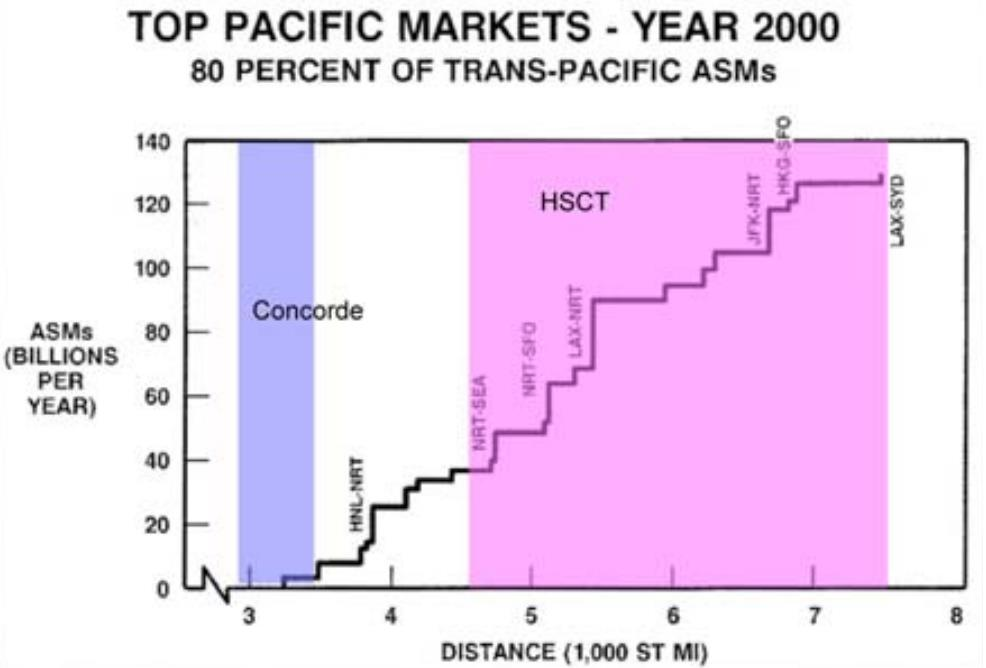
The amount of the market which a vehicle can capture is shown as a function of range. An orbit-capable craft can capture the entire market since its cross-range has global access upon reaching orbital velocity above the atmosphere. However, the orbit-capable vehicle is limited by the available launch sites. To capture as much of the market as possible, it is planned to transport passengers by conventional subsonic means to the nearest launch site before embarking across the world. By doing this, the total time of travel is expected to approximate a supersonic or hypersonic flight, where all high-velocity aircraft will drastically reduce flight time for a premium when compared to conventional air travel available today.
In regards to market capture, currently the best available transport service for important employees and wealthy individuals is a first-class ticket aboard a conventional subsonic aircraft. By these means, travelling from Washington D.C. to Sydney, Australia will take about 22 hours of flight time, not including the time to drive to the airport and make it to the seat of the aircraft. This best available transport today will only allow for extra comfort and accommodations during the flight to allow for a better and more productive transition, but little else can be done to increase logistical productivity when transporting employees or travelling for leisure.
However, purchasing a ticket for high-speed flight will allow for a short flight duration (about an hour), minimizing passenger fatigue and increasing productivity. Important employees such as executives likely cost their employers considerable money for their time, who must be compensated for during a less-productive flight. Additionally, this salary they earn contributes little to the output of the employee during the actual transport, even if the aircraft is enabled with an internet connection. Essentially, the company would much rather have an executive at their destination rather than in-flight. These incentives from a customer company will provide a better argument for paying for the expectedly high price per ticket.
Realistically, due to weight sensitivity and volume constraints, the in-flight accommodations aboard an orbital point-to-point transport will be less than that of a fully-equipped first-class ticket on a larger subsonic vehicle. However, this can be more easily tolerated since the actual flight time is very short and comparable to a daily commute.
The market estimates for supersonic markets are conservative since orbital transport is potentially faster than a hypersonic flight (depending on the onboarding and offloading procedure). An additional conservatism is that customers are more willing to fly on a space vehicle for the cultural prestige and exhilarating experience associated with such a mode of transport. For these reasons, companies and individuals may be willing to pay a premium for tickets and the potential market for space flight is actually much larger than the market for atmospheric supersonic and hypersonic flight.
In addition to the point-to-point market, the civilian vehicle may dock with orbital space hotels. The ticket price for such a capability covers orbital propellant and increased logistics to perform a successful docking with a space station such as an orbital hotel.
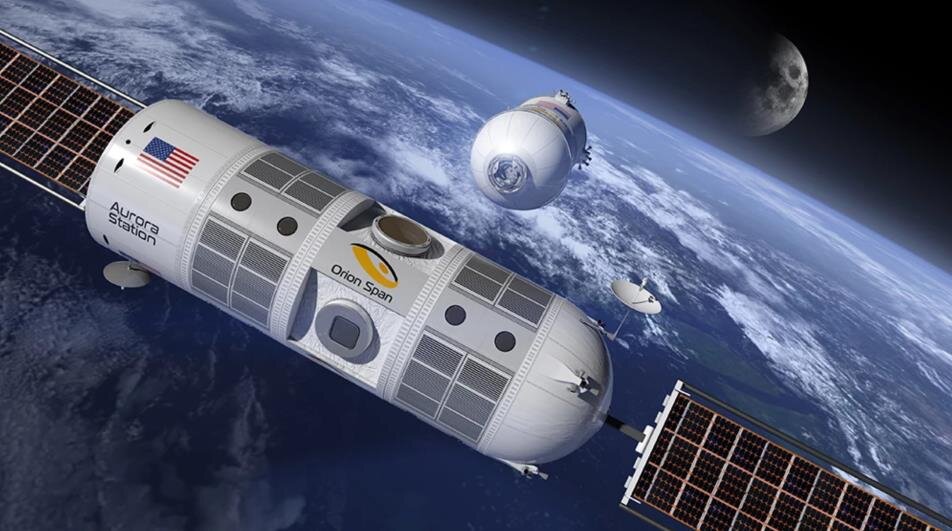
The idea is that other third-party companies will develop the technology for a space hotel if a feasible, reliable mode of transportation were developed. To use an earth-bound analogy, conventional surface hotels are in a symbiotic relationship with the airlines that take tourists to their location, and tourists use airlines to arrive to these hotels. In the same way, a space hotel business could help further increase flight frequency, where multiple hotels will be required to keep up with the logistical capability of a rapid turn-around reusable vehicle.
There has been market research gaging public interest and willingness to spend proportions of individual salaries to go on a trip to a space hotel. The market for paying for transport to low earth orbit is larger than the author expected and allows for enough revenue to support the program proposed by Ascension Aerospace. The tabulated values of market interest are shown below [23].
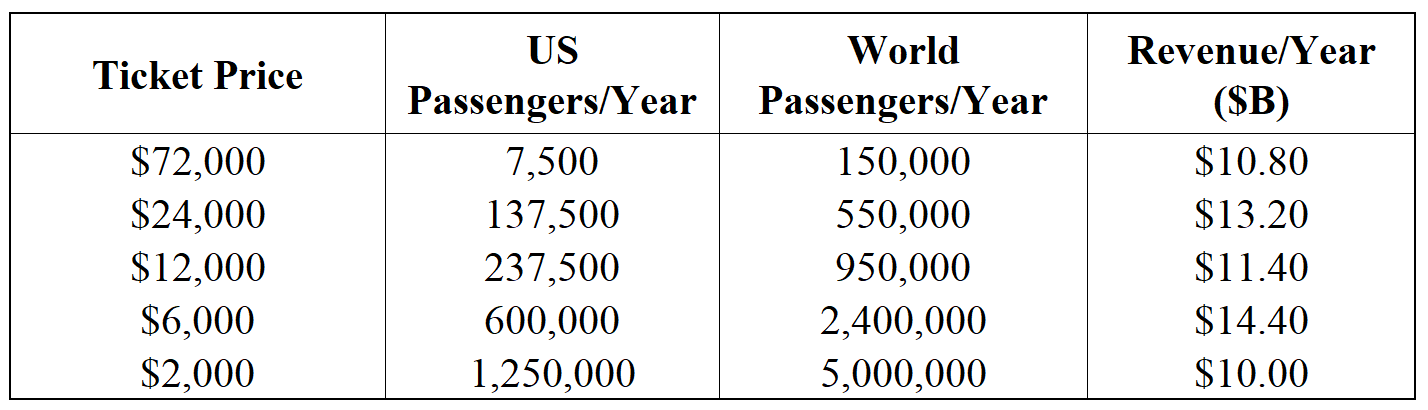
It is worth noting that these numbers are conservative given that the lack of such a service makes market estimates speculative. The source compensated for this by assuming that only 25% of positive respondents would actually purchase a ticket should a service for orbital transport appear. This is a conservatism and does not account for the increased demand after the presence of affordable orbital transport.
The data from this market demand is plotted to visualize how the ticket price will affect the number of flights per year needed to capture the entire global market and generate the potential revenue. The number of flights is based on the expected number of passengers per flight. The Model 176 can carry 16 passengers [1].
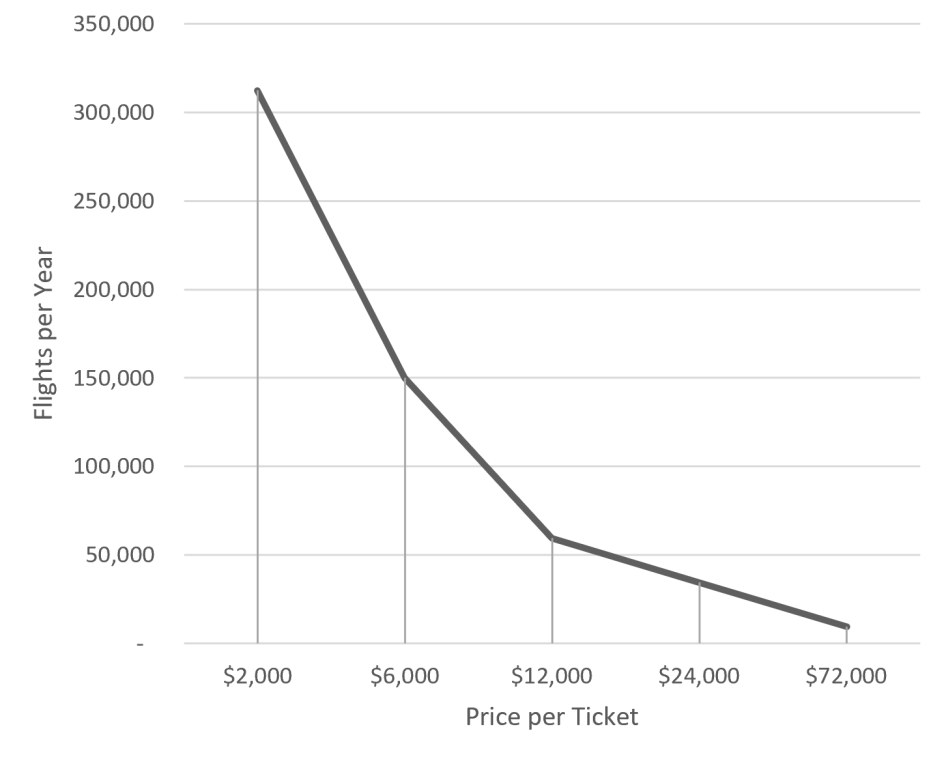
Ticket prices above 72,000 USD are considered too high to allow for a predictable operation and regularly scheduled flights. One of the organizational goals of Ascension Aerospace is to give the general public access to space, and any price above this maximum is deemed too infrequent by the source.
The above demand curve will aid in the development of the annual budget based on potential revenue. This is the starting point for building the civilian business case.
One of the main design missions for the vehicle is military operations. This can fall under two categories: command and control (C & C) or surprise reconnaissance. The first layout will house equipment needed for an extended stay in orbit and will be expected to make frequent, scheduled flights for long-duration military objectives, such as space presence and dominance. The opportunity for premium, reliable contracts exists, particularly given recent presidential initiatives, such as the formation of the Space Force.
The reconnaissance mission is not expected to be nearly as reliable as the civilian market or C & C needs, given that this would only be used for short duration missions for tense, time-sensitive situations. The expected situation is to have a contract with the military to purchase available vehicles whenever they are needed.
BBusiness Strategy
As was mentioned in the introduction, flight frequency is the key to affordable space flight. This strategy was employed after literature research on costing and operations of a space program. An existing analogy for the competitive advantage provided by a rapid turn-around reusable vehicle is that of a roller coaster. If a roller coaster and all its infrastructure and operations were used to support one ride per week, the roller coaster would not be economically viable. The only reason any single roller coaster can stay in business is because a single ride can process several thousand passengers a year.
In the same way, the Model 176 must be used several times per day if it is to remain economically viable. This business need translates to an engineering requirement, where high cross-range is needed as well as increased design robustness for reliability. The cost analysis in the following section will go over how flight rate affects the cost from researched cost data.
CCost
The cost of the engineering development of this hypersonic vehicle is further explored in the Cost Analysis chapter. The operational and logistical costs associated with running the business are explored here.
The cost analysis for a general reusable vehicle is conducted by the Aerospace Corporation which explains the assumptions and methods used to arrive at the results below [23].
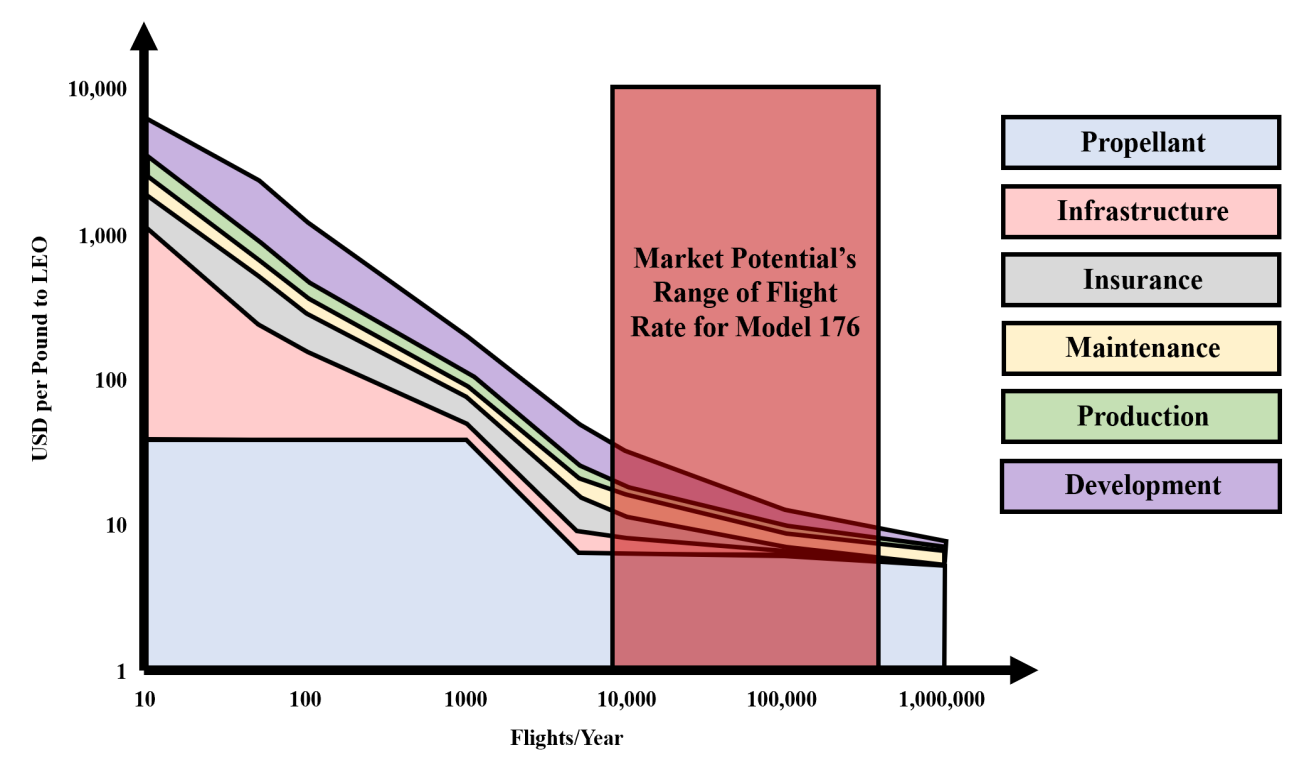
For the given range of flight, the propellant used for the vehicle is kerosene and oxidizer. This can be fine-tuned according to the fuels given by propulsion analysis, but since the launch system uses kerosene, it is deemed an appropriate approximation.
Infrastructure expenses are a function of the yearly flight rate. Fortunately, the infrastructure price per pound in orbit decreases with increasing flight rate since the relationship between flight rate and total infrastructure required is not linear. The cost of infrastructure is tabulated below [23]. Maintenance works in a similar way, with manhours per flight decreasing with increasing flight rate.

The insurance cost is based on the lost value of a single vehicle, which is set at a value of 1.5 to 2 billion USD in the graph above. However, as traffic increases, the reliability of the system is expected to increase as there is more opportunity to develop a solid, safe procedure. Conventional flight today is among the safest modes of transportation, despite being immensely complex and transporting large amounts of people in one flight. This can be attributed to a high industry standard and a long history of many flights per day.
Production and development costs are initial costs which are fairly independent from the number of flights. These up-front costs are amortized among the many flights they were designed to initialize.
DProfit
Now that the market has been assessed and the costs have been computed, the yearly profits can now be evaluated for a 16-passenger orbit-capable transport. Using the results from previous sections, the revenues and costs of a scheduled space program are shown below.
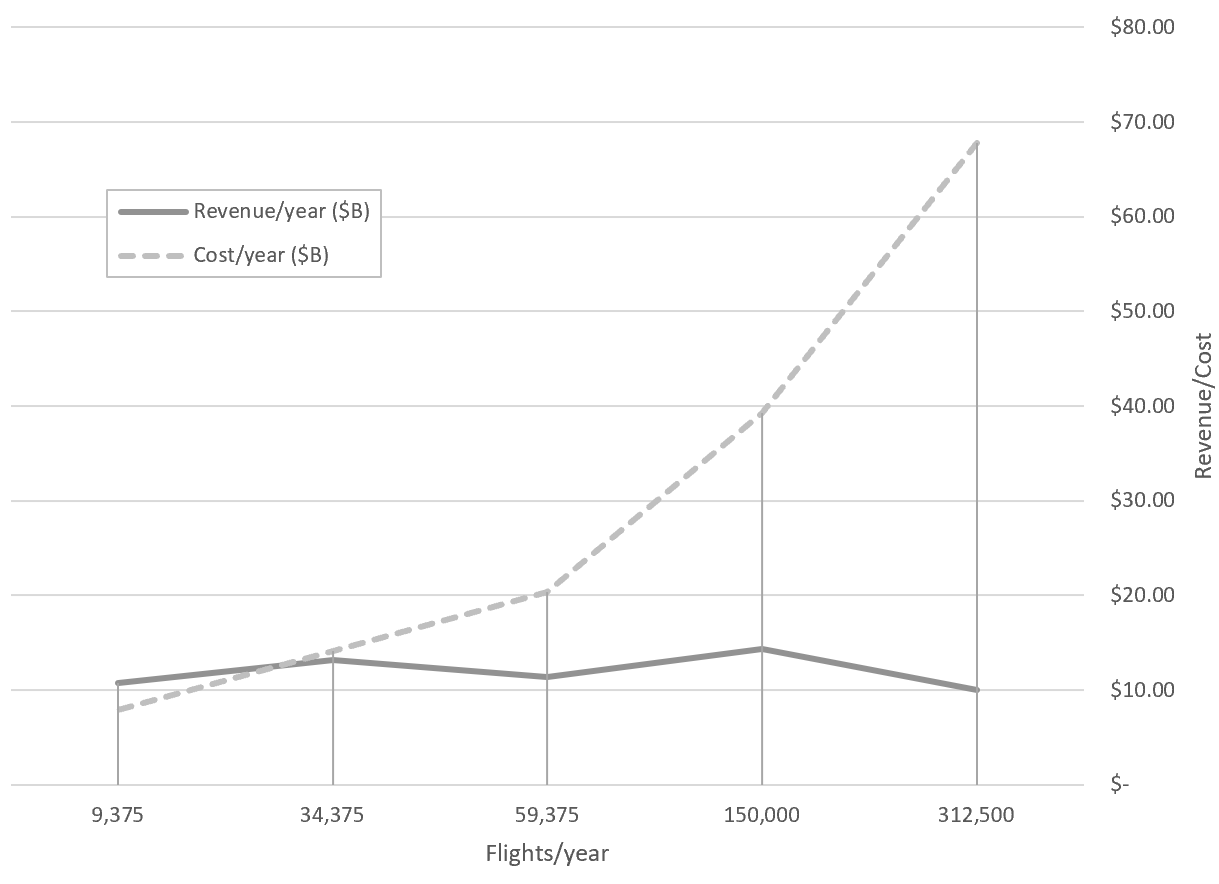
The business model is not profitable for higher launch rates since the total revenue does not match the increased costs of running such a large operation. While the price per payload pound to LEO is cheaper for such high flight rates, the global market is not large enough to pay for it. As previously mentioned, if the flight rate were decreased by increasing the ticket price, there comes a point where the demand is too low for regularly scheduled flights, which would not utilize the vehicle’s high turn-rate capability.
When the flight rate is decided, the ticket price can be determined and the target market within the global market can be determined and catered to. The plot below shows that the flight rate must be kept at a minimum to maximize profits while maintaining regularly scheduled flights with the Model 176. The market size is what constrains the number of flights per year. If the conservative estimates under-represent the true market size (this will shift the revenue curve upwards), the operations can always be scaled up to maximize profits.
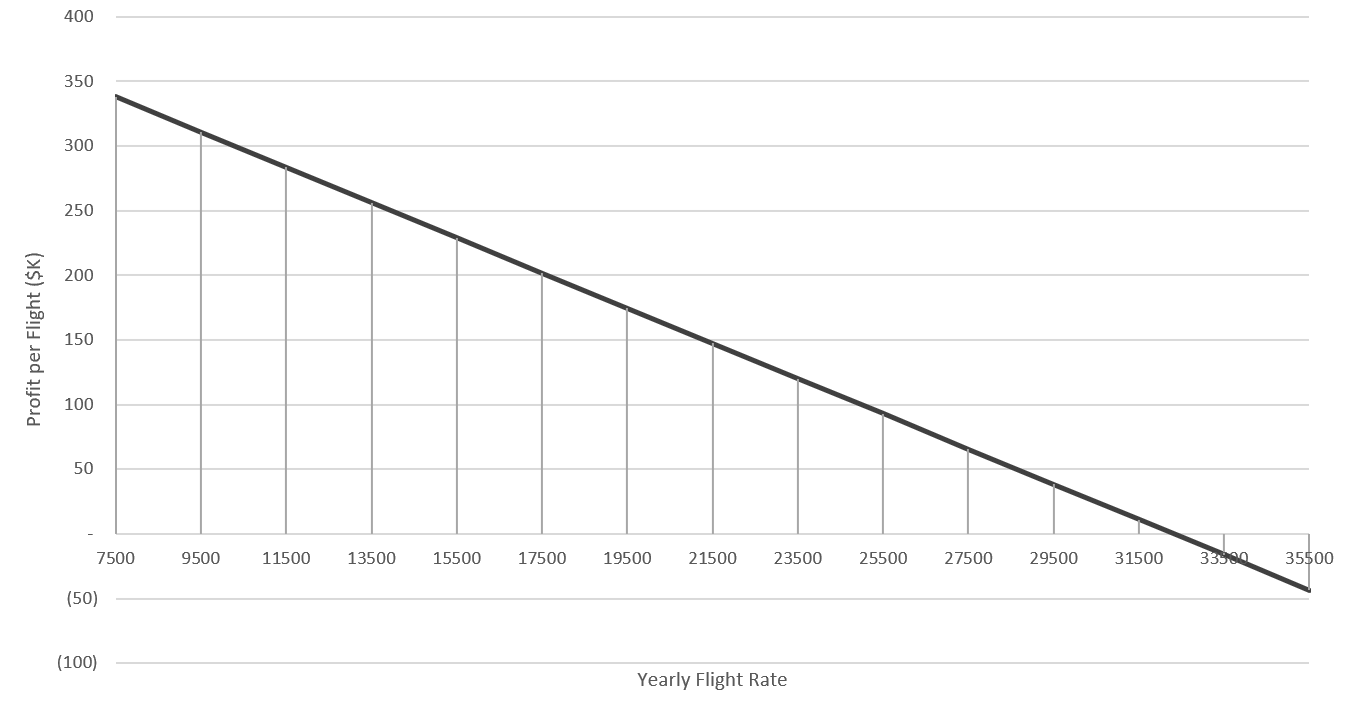
The cross-over point for a profitable operation is at around 32,000 flights per year. Again, this cross-over point will shift upwards as the market demand increases.
ESelected Scale
The selected flight rate is chosen to be 8,760 per year since this corresponds to one flight per hour year-round. This is also close to the lower limit of regularly schedules flight rates for a vehicle of this size. The price per ticket can be determined as an extrapolation of the market data and is found to be 73,200 USD. By extrapolating the demand curve, the decrease number of flights allows the operation to slightly increase the ticket price. This is helpful since a decreased flight rate also increases the price per flight, as shown in previous sections.
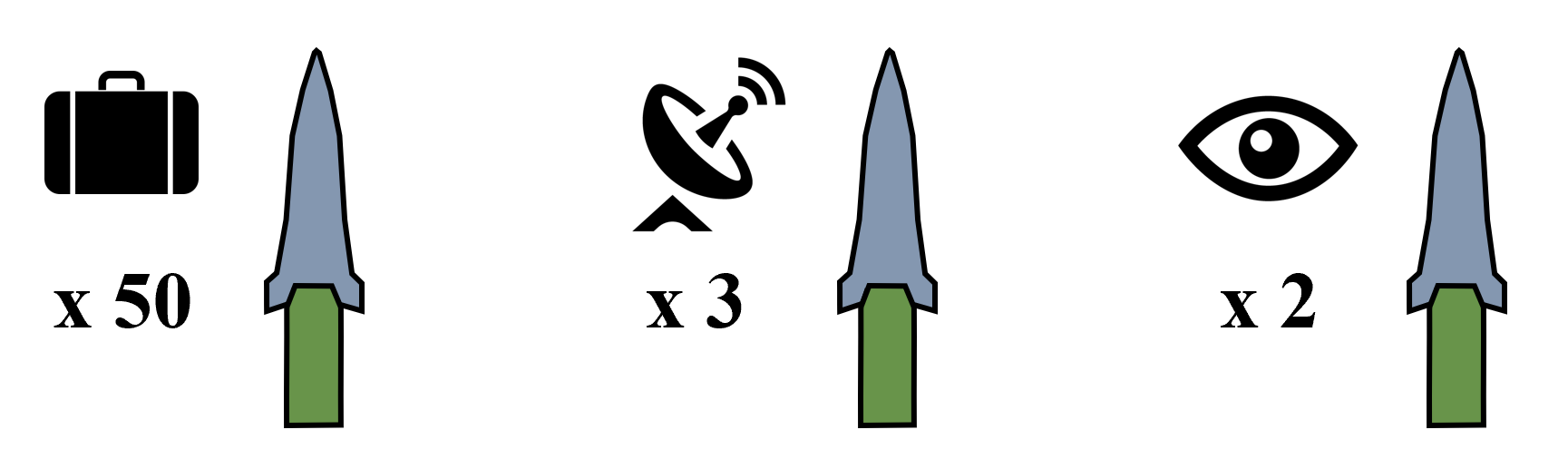
The expected turn-around time is dependent on the size of the fleet. If the turn-around time for these vehicles were once a day (which is the optimistic limit), then a fleet of 25 vehicles can be maintain operations. At the conservative estimated turn-around time of 48 hours, a fleet of 50 vehicles is required to meet market demand. The extra vehicles are to allow slack for maintenance and emergencies. It is quite possible that the initial flight rate is not attainable due to constant learning and troubleshooting at the early stages of operation.
The fleet will also include military variants paid for by the Department of Defense, but this cannot be predicted or scheduled in the same way as market demands. The monetary value of these contracts will need to be assessed separately. However, the civilian supported infrastructure will allow for a lower operational cost for these special vehicles.
FOperations
Regular operation will include launching the vehicle from one site to another, which will require an up-front cost in infrastructure investment. The sites will be placed strategically around the globe to capture as much of the global market as possible. As previously mentioned, one-way trips allow for more flexibility since such a mission profile only requires a runway at the end of the flight. However, transporting the upper stage back to a launch site may take more resources and turn-around time.
While launching from site to site allows for quick recuperation, it is worth noting that half of the trips on the way back will be going against the Earth’s rotation. This will increase the delta V loads on the launch system. This is not expected to be a design concern, however, since the launch system is designed to carry the reconnaissance layout. Additionally, the way back can still access orbit the conventional way (flying in the same direction as the Earth’s rotation) and reach any destination from here. This will be a slightly longer flight since the vehicle is going the long way around, but orbital speeds are high enough to make this slight increase in distance trivial in contribution to the total flight time. The direction of flight depends on the surface geography as the vehicle cannot launch over land due to safety concerns.
The potential launch sites are designed to capture the global market, where many are existing today. Acquiring the permissions required to launch to and from foreign nations is expected to be a lengthy process, and may limit the market to trans-Atlantic, Australian and Japanese flights. It may be easier to build a new retro-grade launch site (launched against the Earth’s orbit) in Ireland.
There is also a dearth of launch sites closer to the South Pole. Their associated high-inclination orbits can be accessed by the high cross-range capability of the vehicle or synergetic maneuvers. In the same way, vehicles launched from here can access other parts of the globe. Unfortunately, the inner parts of the continents are not available for access due to safety concerns of a potential failed launch. The Russian launch site is an exception since the land below the launch path (launching easterly) is sparsely populated.
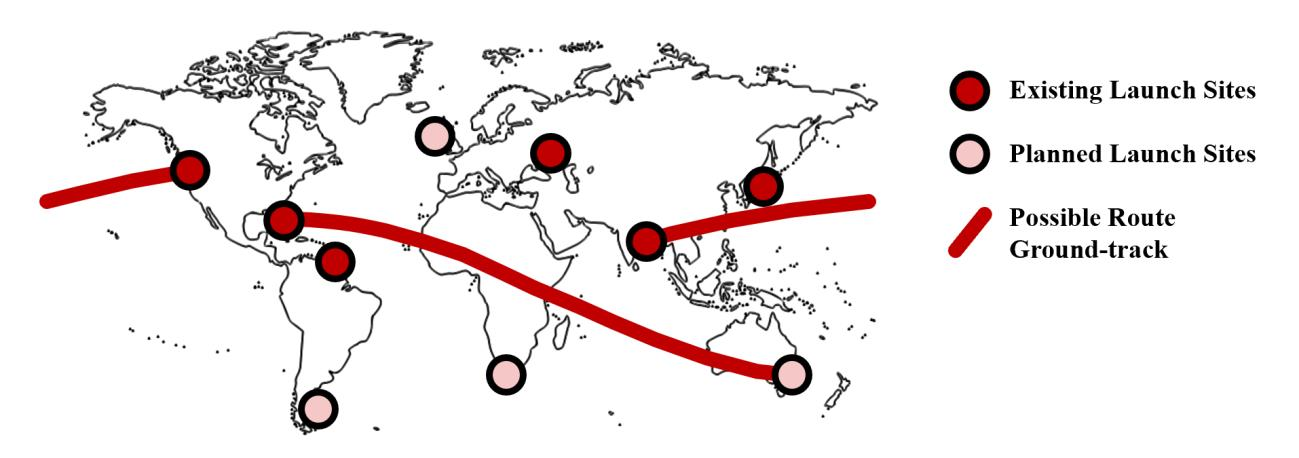
Using a Russian launch site may prove to be difficult due to geopolitical reasons. The idea of orbit-capable vehicles (potential missiles) being launched from the Russian landmass to the United States or vice versa is not something either nation is likely to tolerate. China does not have available civilian launch sites for this reason.
Military operations are likely to be less frequent (especially if Command and Control is staying in space for an extended period of time), but they will be supported by the civilian infrastructure. The pricing will be higher than a civilian variant, since the development amortization costs are much higher for the military fleet size.
For the reconnaissance variant, the expectation is that the mission will be unexpected and of short duration. This is to allow the military to respond to a fast-paced situation and will likely use a scheduled flight as the fastest means to take-off. The civilian flight will be cancelled, but the passengers will be compensated for the delay (since there are 24 flights per day, this shouldn’t be very long). The military will have a contract to cover the development and deployment of a unique variant on such short notice.
GCompetition Analysis
A direct competitor to the point-to-point variant is the airline industry. This currently captures the majority of the human transportation market for global coverage. It is the fastest mode of transportation available for business travelers and tourists, and it is the market Ascension Aerospace intends to disrupt.
The current going rate for a round-trip first-class ticket is close to 10,000 USD, and takes about a day per flight, with one stop. The Point-to-Point variant costs 73,200 USD for a one-way, non-stop flight and will take about an hour. The price of the point-to-point ticket is a major disadvantage, but it should be noted that the time of flight also costs money to business travelers. For a highly compensated executive, the difference in travel time may be worth the increased ticket price. If the difference between flight times is 20 hours, then the value obtained from not having an executive travelling can be worth the extra expense.
In 2013, the median chief executive salary was an annual 11.4 million USD [24]. If a 60-hour work-week is assumed for executives, then money lost in productivity for a 20-hour difference in travel time can easily be determined. The value of that time is 76,000 USD, which is a little bit more than the price of a ticket and easily covers the difference in price for a one-way trip (68,000 USD). Considering the round-trip doubles these differences. This is a very rough estimate, as the compensation of an executive is largely determined by returns and aren’t exactly paid by hour. However, time is very valuable with that level of compensation, as executives are expected to produce more than that value for their shareholders per year. The value of an executive’s time may fluctuate according to the state of his or her company, but these median values give a rough idea of how a faster travel time may have monetary value that allows for orbital ticket purchases. It is worth noting that if the executive can be productive on an airliner, much of the difference in value with respect to travel time can be reduced. However, there will always be more value in appearing in person for the reason of travel than conducting business on an aircraft. There are also emotional benefits to a reduced travel time.
This comparison does not include the excitement and perk of travelling to space while working, of which an adventurous executive may be willing to help pay for. The market analysis in the first section of this chapter should cover a lot of public enthusiasm for leisure travelling as well.
SpaceX is offering a service most similar to the point-to-point variant. Since the service is mostly under proprietary development, the following analysis is deduced from the author’s speculations and SpaceX’s promotional video [25], where the hope is that a rational assessment of both of the vehicle’s capabilities is considered sufficient supporting evidence.

The ballistic trajectories used by SpaceX’s BFR (Big Falcon Rocket) are unlikely to be considered safe to the destination cities. Regional government approval for a vehicle approaching their coastlines is difficult to obtain. They must also land on specialized launch pads, which passengers may not deem as safe or comfortable as a runway landing. These launch pads are accessed by a sea vehicle (adding to travel time). Clearly, landing as a conventional aircraft increases the destination flexibility and its receptibility (can travel further inland). It is acknowledged that the passengers for the Point-to-Point variant proposed by Ascension Aerospace are supposed to travel to the launch site, but since this site is based on land, it is accessible by a commuter airline or ground transportation.
Blue Origin is not proposing to build a point-to-point transportation system around their vehicle (New Shephard), but they do share the market for space tourism. The company is making progress towards man-rating the vehicle and both the first stage and capsule is recoverable. However, the performance of this vehicle is significantly lower than the Model 176, particularly in its range capacity. This vehicle will also not have access to an orbital space hotel, though the New Glenn will (still in development). Each flight will take 6 tourists, whereas the Model 176 will seat 16.
Spotted an error, or want to reply? Email me: leonardo.pinero42 [at] gmail [dot] com